
Bladder cancer on Harley Street refers to specialist private diagnosis and treatment for bladder cancer at medical practices along this renowned London medical district. You get access to consultant urological surgeons who focus on bladder cancer, advanced diagnostic equipment, and treatment options like robotic surgery.
This guide walks you through everything you need to know about getting bladder cancer care on Harley Street. You’ll learn how to access specialist consultants, what tests and diagnosis involve, the treatment options available including cutting edge robotic procedures, and how to book your first appointment. Whether you’re seeking a diagnosis, second opinion, or treatment plan, you’ll understand exactly what private bladder cancer care offers and how to take your next steps with confidence.
Why Harley Street bladder cancer care matters
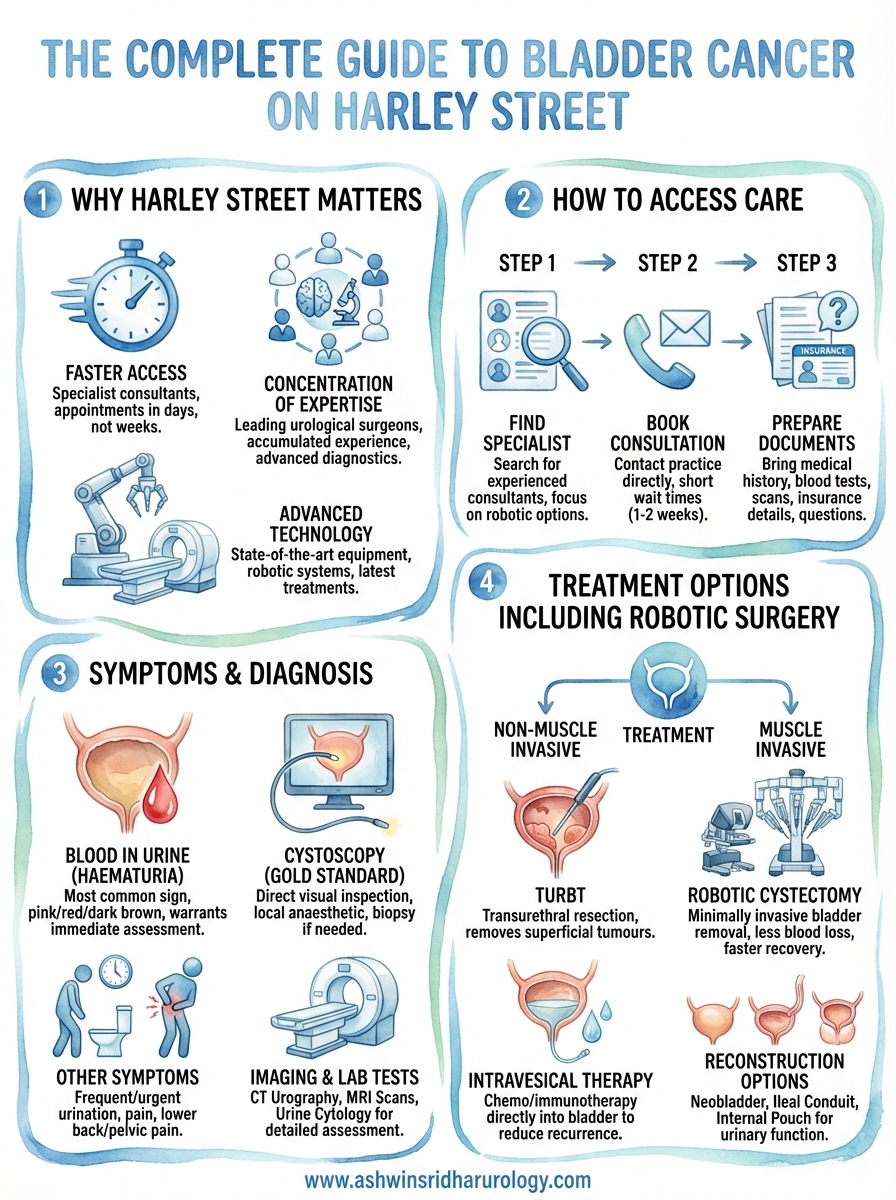
You get faster access to specialist consultants when you choose bladder cancer Harley Street care compared to NHS waiting times. Most private practices can arrange your first appointment within days, not weeks or months. This speed matters crucially when you need answers about blood in your urine or other bladder symptoms that worry you.
Concentration of expertise and technology
Harley Street brings together the UK’s leading urological surgeons in one central London location. You find consultants who perform hundreds of bladder cancer procedures yearly, giving you access to accumulated experience that directly improves your treatment outcomes. The district houses advanced diagnostic equipment and state of the art robotic surgical systems that many NHS hospitals don’t currently offer.

Specialist concentration means you can get second opinions without travelling across different cities.
Your care benefits from the latest treatment approaches because Harley Street consultants often lead clinical research and adopt new surgical techniques first. Treatment plans reflect current best practices rather than outdated protocols. Private facilities also coordinate your entire care pathway more seamlessly than fragmented NHS services.
How to access bladder cancer care on Harley Street
You start by identifying specialist urological surgeons on Harley Street who focus on bladder cancer treatment. Search for consultants with extensive experience in bladder cancer diagnosis and surgery, particularly those offering robotic surgical options. Most practices display detailed profiles online showing qualifications, specialisms, and patient testimonials that help you assess their expertise.
Booking your consultation
Contact the consultant’s practice directly through their website enquiry form or telephone number. You can book bladder cancer Harley Street appointments with or without a GP referral letter, though having one helps your consultant understand your medical background. The practice administrator collects basic information about your symptoms and arranges your appointment slot within days.

Most practices schedule your first consultation within one to two weeks of your initial contact.
What to bring
Gather all relevant medical documents including recent blood tests, imaging scans, and your current medication list. Bring your insurance details if you plan to claim costs through private medical insurance. Write down questions you want to ask during the consultation so you don’t forget important concerns about diagnosis or treatment options.
Understanding bladder cancer and its symptoms
Bladder cancer develops when abnormal cells grow uncontrollably in your bladder lining. These cells form tumours that range from non-muscle invasive (confined to the bladder lining) to muscle invasive (spreading into the bladder wall). Your bladder stores urine before you pass it, so cancer here directly affects your urinary function and causes noticeable symptoms you shouldn’t ignore.
Common warning signs
Blood in your urine (haematuria) stands out as the most frequent symptom, appearing pink, red, or dark brown. You might spot it once then not see it again for weeks or months, but any occurrence needs investigation. Your bladder may feel irritable, causing frequent urination, sudden urgent needs to go, or pain when passing urine.

Any blood in your urine warrants immediate medical assessment, even if it disappears after one episode.
Additional symptoms include persistent pain in your lower back or pelvis, which can signal more advanced disease. You might notice unexplained weight loss or constant tiredness alongside urinary changes. These symptoms overlap with other conditions, which makes professional diagnosis essential rather than self-assessment.
When to seek specialist care
Contact a bladder cancer Harley Street consultant immediately if you spot blood in your urine or experience persistent bladder symptoms lasting beyond two weeks. Don’t wait for symptoms to worsen or assume they’ll resolve naturally. Early detection significantly improves your treatment outcomes and increases your chances of complete recovery.
Tests and diagnosis on Harley Street
Your diagnostic journey starts with a detailed consultation where your consultant reviews your symptoms and medical history. Bladder cancer Harley Street specialists use advanced diagnostic equipment located on-site, which eliminates delays between different hospitals or imaging centres. You typically complete most tests during your first or second visit, receiving results within days rather than waiting weeks through NHS pathways.
Cystoscopy examination
Cystoscopy forms the primary diagnostic tool for bladder cancer detection. Your consultant inserts a thin, flexible camera tube (cystoscope) through your urethra to examine your bladder lining directly. This procedure happens under local anaesthetic in the consulting room and takes approximately 15 minutes. The camera transmits real-time images to a screen, allowing your consultant to spot abnormal tissue immediately and take biopsy samples if needed.
Direct visual inspection through cystoscopy remains the gold standard for bladder cancer diagnosis.
Imaging and laboratory tests
CT urography produces detailed images of your entire urinary tract, helping consultants assess tumour size and check for spread to kidneys or ureters. You receive a contrast dye injection that highlights your urinary system during the scan. MRI scans provide additional detail about muscle invasion when consultants need to plan surgical approaches. Your consultant also arranges urine cytology tests where laboratory technicians examine your urine samples for cancer cells under microscopes, offering another diagnostic confirmation beyond visual inspection.
Treatment options including robotic surgery
Your treatment depends on whether your bladder cancer remains non-muscle invasive (confined to the lining) or has become muscle invasive (spread into the bladder wall). Bladder cancer Harley Street consultants tailor your treatment plan based on tumour stage, grade, and your overall health. Private facilities offer the full spectrum of treatments from minimally invasive procedures to advanced robotic surgery, giving you access to options that suit your specific diagnosis.
Non-invasive treatments
Transurethral resection (TURBT) removes superficial tumours through your urethra using a specialised instrument called a resectoscope. Your consultant performs this procedure under general anaesthetic, cutting away abnormal tissue without external incisions. Following TURBT, you often receive intravesical therapy where chemotherapy or immunotherapy drugs go directly into your bladder through a catheter, reducing recurrence risk significantly.
Intravesical treatments deliver medication precisely where cancer cells form, minimising side effects throughout your body.
Robotic cystectomy
Robotic surgery transforms bladder cancer treatment through the da Vinci surgical system, which your consultant controls with precise hand movements translated into tiny instrument motions. This approach removes your entire bladder (radical cystectomy) through small keyhole incisions rather than large open cuts. You experience less blood loss, reduced post-operative pain, and faster recovery compared to traditional surgery, typically leaving hospital within one week instead of two.

Bladder reconstruction options
After cystectomy, your consultant creates a new way for your body to store and pass urine. Neobladder reconstruction builds a replacement bladder from your intestinal tissue, allowing you to urinate naturally through your urethra. Alternatively, your consultant may create an ileal conduit where urine flows into an external collection pouch, or fashion an internal pouch you empty through a small abdominal opening using a catheter several times daily.
Next steps and support
Your path forward starts with booking your initial consultation where a specialist assesses your symptoms and medical history. Bladder cancer Harley Street consultants provide ongoing support throughout your treatment journey, coordinating all aspects of your care from diagnosis through recovery. You receive regular follow-up appointments to monitor your progress and catch any recurrence early through scheduled cystoscopies and imaging.
Support extends beyond medical procedures to include nutritional guidance, rehabilitation services, and psychological support when needed. Your consultant connects you with specialist nurses who answer questions between appointments and help manage any side effects from treatment. Private care ensures you have direct access to your surgical team rather than navigating through multiple departments.
Book your consultation to discuss your symptoms and receive a comprehensive assessment from an experienced urological surgeon. Taking this step now gives you clarity about your diagnosis and access to advanced treatment options that can make a significant difference to your outcome.